‹ Sensors · Agriculture ›
Capacitive (volumetric soil moisture)
Measures soil volumetric moisture so you irrigate with criteria: not by calendar or guesswork, but by the crop’s real need.
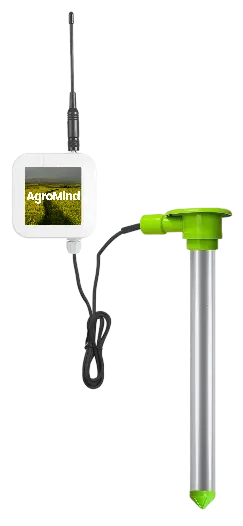
What it measures and why it matters
Measures soil volumetric water content (VWC), i.e., how much water is actually in the root zone. It’s the basis for irrigating with criteria: not by calendar or “gut feeling”, but by the crop’s real need.
How it works
The sensor detects changes in soil permittivity, which varies with water content. This allows you to estimate moisture continuously and compare trends across days/plots.
‹ Use cases ›
Which crops and situations benefit most
Vineyards and olive groves
Fine-tune regulated deficit irrigation, avoid excessive stress
Fruit trees
Prevent stress spikes and improve uniformity
Vegetables
Short, frequent irrigations; optimize fertigation
Cereals / extensive crops
Season tracking and intervention windows
‹ Data ›
Parameters and how to interpret the data
Moisture (VWC)
Available water level
Trend (up/down)
Crop consumption vs irrigation/rain input
Dry-down rate
Sandy soils dry fast; clay soils slower
Plot thresholds
Adjusted by soil, depth, and yield target
‹ Setup ›
Quick installation
- 01
Choose a representative area (avoid headlands, puddles, heavy traffic)

- 02
Install at root depth (one or multiple depending on management)
- 03
Lightly compact around it for good soil contact
- 04
Assign the sensor to the plot in AgroMind
- 05
Validate first readings (coherent trends after irrigation/rain)
‹ Spec sheet ›
Specifications and design
Materials / ruggedness
IP67 housing, resistant to field conditions
Rugged battery
Up to 5 years autonomy with replaceable battery
Built-in location
Built-in location for follow-up
Made in Spain
Designed and manufactured in Spain
2-year warranty
2-year manufacturer warranty
‹ FAQ ›
Frequently asked questions
Do I need calibration by soil type?
Not essential for most uses. The capacitive sensor works well across different soil types. However, if you need absolute accuracy, you can do a specific calibration by comparing with lab samples.
What depth should I install it at?
It depends on the crop and root depth. In general: 20–30 cm for vegetables, 30–40 cm for vineyards/olive groves, 40–60 cm for fruit trees. You can install multiple sensors at different depths for full profile monitoring.
Can it be used in stony soils?
Yes, but look for spots with enough soil contact. Lots of stones can affect readings. The key is good contact with the soil matrix around the sensor.
How do I detect over-irrigation with VWC?
If VWC stays consistently high (near saturation) and doesn’t drop between irrigations, it may indicate excess water, poor drainage, or over-irrigation. Trends and dry-down rate give clear clues.
How many sensors do I need per plot?
It depends on plot size and variability. For a homogeneous 1–2 ha plot, 1–2 sensors can be representative. In large or highly variable plots (slope, texture), you’ll want more.
Does the sensor work in winter?
Yes, it works year-round. In very cold or frozen soils, readings can be affected, but the sensor remains operational and recovers accuracy as conditions normalize.
How does fertigation affect readings?
Fertigation can slightly increase soil water conductivity, which may have a small effect on capacitive readings. In normal management, the effect is minimal and doesn’t impact irrigation decisions.
Can I move the sensor?
Yes, but keep in mind you’ll lose the historical continuity for that exact location. If you move it, mark it in the platform and allow 1–2 days for stabilization before relying fully on new readings.
‹ Free demo ›
Let's talk about your farm,
no strings attached
Tell us hectares, crop and whether you already have sensors. Reply in under 24 hours with the path that fits you best.