‹ Sensors · Agriculture ›
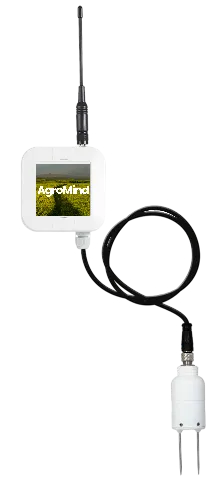
Electrical conductivity sensor
Controls salinity and salt concentration in soil. Key for precise fertigation and avoiding salinity stress.
What it measures and why it matters
Measures electrical conductivity, related to dissolved salts. Used to: detect salinity or accumulation from irrigation/fertigation, adjust leaching strategies, understand nutrient uptake блокages and osmotic stress.
How it works
The sensor measures soil electrical conductivity, which increases with dissolved salt concentration. It enables real-time monitoring of salinity and operational decisions.
‹ Use cases ›
Which crops and situations benefit most
Greenhouses and intensive vegetables
Precise fertigation and salinity control
Areas with hard or saline water
Early detection of salt build-up
Plots with salinization history
Continuous monitoring and leaching adjustments
‹ Data ›
Parameters and how to interpret the data
Electrical conductivity (EC)
Value in dS/m or mS/cm
Sustained increases
Possible salt accumulation
Spikes after fertigation
Normal if it later stabilizes
Compare zones
Detect problematic sectors
‹ Setup ›
Quick installation
- 01
Install in a representative area

- 02
At active root depth
- 03
Ensure good soil contact
- 04
Link it to the plot
- 05
Validate response after fertigation
‹ Spec sheet ›
Specifications and design
Materials / ruggedness
Resistant to field conditions and salts
Rugged battery
Long autonomy
Built-in location
Built-in geolocation
Made in Spain
Made in Spain
2-year warranty
2-year warranty
‹ FAQ ›
Frequently asked questions
Is soil EC the same as water EC?
No. Water EC measures dissolved salts in irrigation water. Soil EC measures salt concentration in the soil solution, influenced by irrigation water, fertilizers, and soil processes.
How do I know if I have too much salt?
It depends on crop and soil, but soil EC above 2–3 dS/m starts to be problematic for sensitive crops. Above 4–6 dS/m affects most crops.
Should I measure it together with moisture?
Absolutely. Moisture + EC gives a complete picture: how much water there is and what salt concentration it has. Both determine water availability to the plant.
What should I do if EC rises a lot?
Leaching irrigation: apply water (ideally low-EC) to wash salts below the root zone. Improve drainage if the issue is recurrent.
Does EC vary with depth?
Yes. Salts often accumulate more near the surface or where water evaporates. Measuring at different depths helps understand the salinity profile.
Do fertilizers increase EC?
Yes, fertilizers are salts. That’s why EC goes up after fertigation. The key is that it later stabilizes and doesn’t keep rising indefinitely.
Can it be used in organic farming?
Yes. The sensor only measures — it doesn’t apply anything. It’s a monitoring tool useful for any farming system, including organic.
How does temperature affect EC?
EC increases slightly with temperature. Modern sensors usually include automatic temperature compensation to provide comparable values.
‹ Free demo ›
Let's talk about your farm,
no strings attached
Tell us hectares, crop and whether you already have sensors. Reply in under 24 hours with the path that fits you best.